

Black clothing does not require a particular metal, chain length, or number of pieces. It simply gives jewelry a relatively quiet background, so placement, scale, and surface finish are easier to notice. The useful question is therefore not “What always goes with black?” but “Where do I want the eye to land?”
Start with one piece and look at it with the complete outfit. A necklace changes the area around the neckline; earrings frame the face; a ring or bracelet adds detail lower in the silhouette. Once that first choice works, it becomes easier to decide whether a second piece adds anything.
Start with the Neckline, Not a Fixed Rule
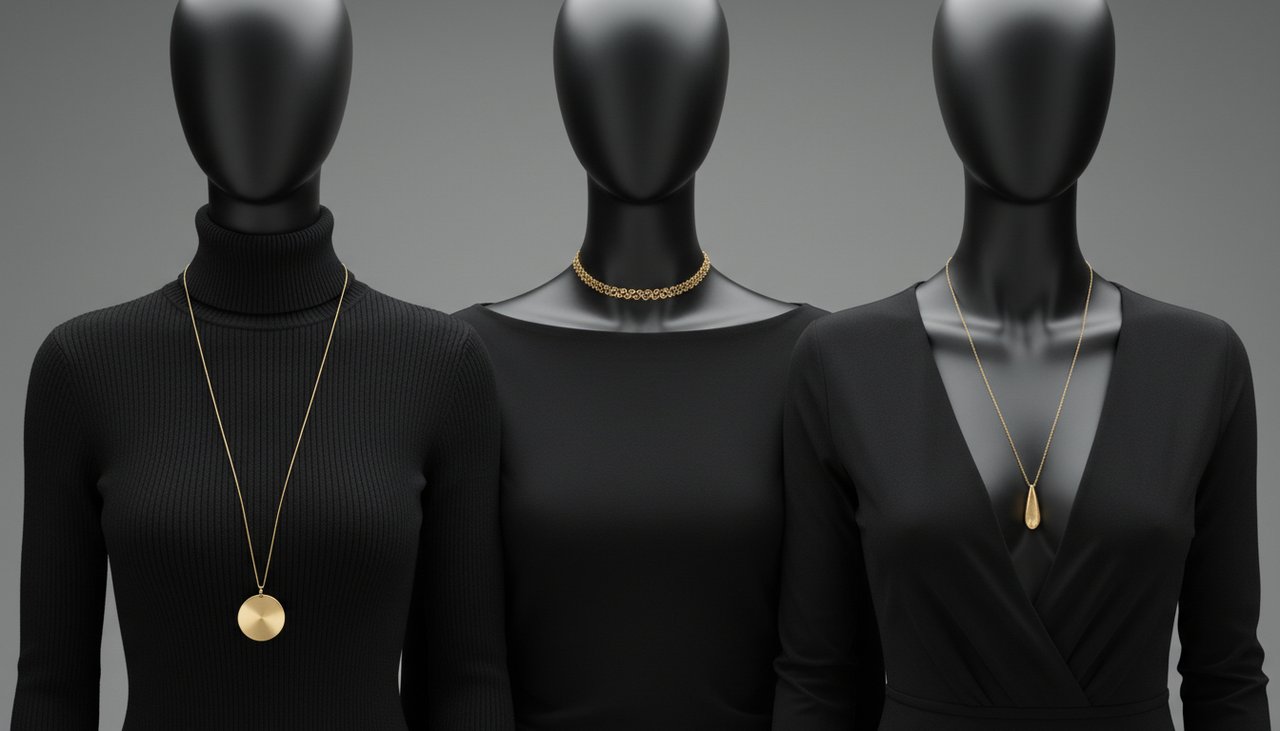
A necklace can sit on bare skin, cross the edge of a neckline, or rest entirely over fabric. Each placement creates a different line. Rather than assigning one chain length to every crew neck, V-neck, or turtleneck, use the garment itself as the reference.
Put on the top or dress and use a piece of string to test where you want a chain or pendant to end. Measure that string, then compare the result with the product’s stated length. If the necklace has an extension chain, read the full range; if it is fixed-length, there may be no adjustment after purchase. Pendant dimensions matter too because the pendant hangs below the chain.
For a V-neck, you might keep a pendant clearly inside the open area or place it above the fabric edge. With a high neckline, decide whether the necklace should remain near the neck or be long enough to sit visibly over the garment. Neither approach is universally better. What matters is avoiding an accidental meeting point where the pendant repeatedly catches or disappears at the neckline.
Sereniso’s silver necklaces state their available lengths and extension ranges on the individual product pages, so compare the number you measured with the exact listing rather than with a general “short,” “medium,” or “long” label.
Choose Where the Contrast Comes From
Against black, contrast can come from more than color. A polished surface produces sharper reflections, while a matte, hammered, or antiqued surface breaks up the light. A fine chain creates a narrow line; a wider band or larger hoop occupies more visual space even when the metal tone is the same.
The fabric changes the result as well. Smooth fabric can reflect light alongside polished metal, while knit, denim, or other textured material gives the jewelry a different background. This is easiest to judge in the light where you expect to wear the outfit. A quick phone photograph from a normal viewing distance is often more informative than studying each piece close to a mirror.
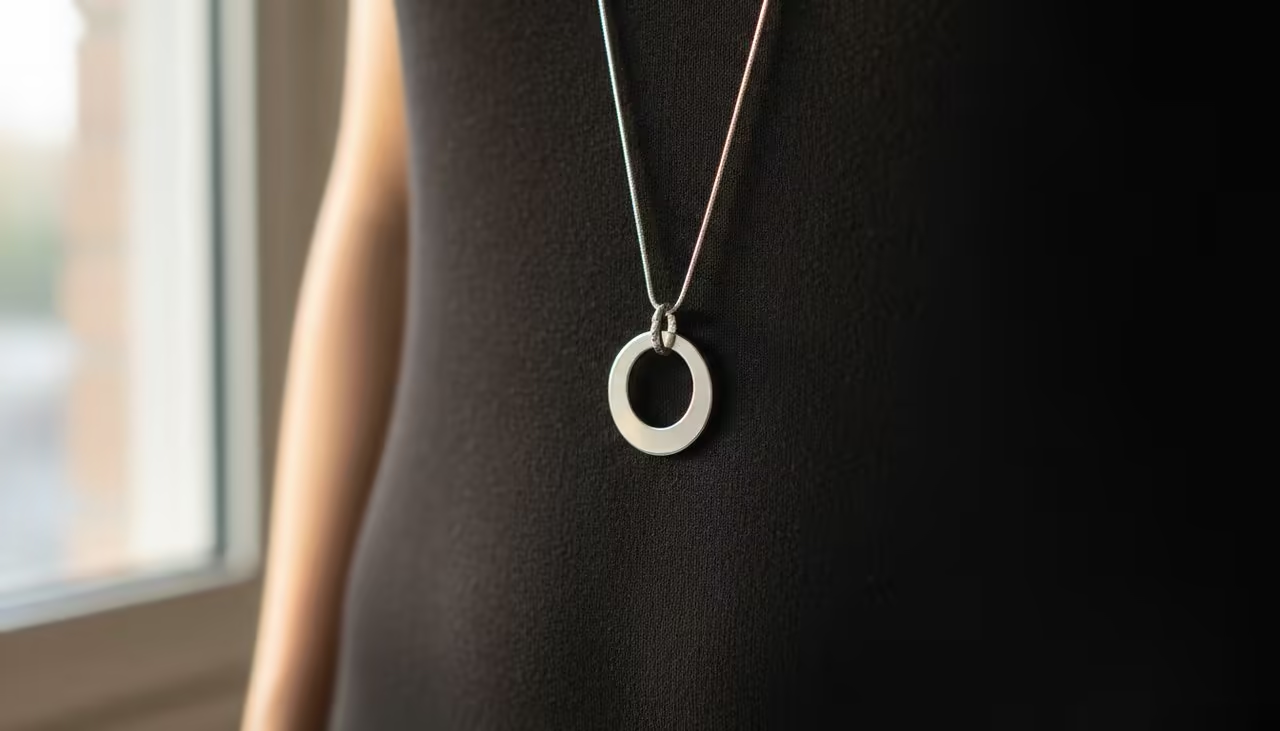
If you are combining a necklace with earrings, rings, or a bracelet, repetition can make the group feel connected. That might mean repeating a silver tone, a rounded shape, or a textured finish. The pieces do not need to be identical, and mixed finishes can work when the difference looks intentional.
Add Pieces One at a Time
A black outfit can support one noticeable piece or several quiet ones. Begin with the item you most want to wear, then add only what improves the overall balance.
- If the necklace is the focal point, compare its endpoint with the neckline and keep nearby earrings simple enough that both remain distinct.
- If the earrings lead, check their size against your hair, collar, and glasses rather than assuming a particular face shape requires a particular design.
- If the detail is on the hands, compare the width and finish of silver rings with any bracelet or watch already present.
- If you want several pieces, repeat one element and vary another—for example, a shared metal tone with different shapes.
Scale is worth comparing with the garment rather than naming in isolation. A slim ring may be clearly visible when the sleeve and fabric are plain, while a wider ring or open bangle already occupies enough space to stand alone. The same applies at the neckline: a small pendant and a plain chain can have different visual weight even when their overall length is identical. Product photographs help with shape, but the supplied width, diameter, pendant size, and chain thickness give a more dependable basis for comparison.
When several pieces are involved, look for collisions before looking for more variety. A bracelet and watch may meet at the same point on the wrist. Two pendants may settle at the same height even though their chains have different listed lengths. Rings with pronounced textures may read as a group more quickly than smooth bands of similar width. These are not reasons to avoid combining them; they are details to notice while deciding whether each piece remains visible on its own.
Movement is part of the decision. Chains may shift across a neckline, bracelets can meet a sleeve or watch, and rings are seen from several angles as the hands move. Wear the combination for a few minutes before adding another layer. If two pieces continually overlap or compete for the same space, changing placement may help more than changing the metal.
For a quick comparison, try the outfit three ways: first without jewelry, then with one chosen piece, and finally with the full combination you are considering. The difference between those views usually makes the focal point easier to identify. Remove or reposition the item that does not have a clear role. This keeps the decision tied to what you can actually see instead of to a rule about how black clothing is supposed to be styled.
There is no required finishing piece. A black outfit can remain spare, carry one clear point of contrast, or support a group of jewelry with repeated details. The most reliable approach is to choose the position first, verify the item’s actual measurements, and build outward from one deliberate choice.
Frequently Asked Questions
It can. Black gives silver a visually quiet background, so the piece's position, width, and finish may be more noticeable. Check the complete outfit in its actual lighting instead of treating silver as the only correct metal for black clothing.
Yes, if you like the combination. Black clothing does not require one metal tone. You can repeat each tone in separate pieces, or let one metal lead and use the other as a smaller accent; check the complete outfit rather than relying on a fixed matching rule.
There is no required number. Start with the piece you most want to wear, then add another only if it improves the balance or repeats a useful detail such as metal tone, shape, or finish.