

Wrist circumference and bracelet length are not the same measurement. Wrist circumference is the snug distance around the place where you will wear the bracelet. Bracelet length describes the piece itself, but a seller may mean overall end-to-end length, usable inner circumference, an adjustable range, or a rigid bangle’s inner diameter.
Measure your wrist first, then match that number to the measurement definition on the individual product page. Do not add a universal amount of “extra room” before you know the bracelet’s construction and how the seller defines its size.
Know which number you are comparing
| Term | What it should describe | Common mistake |
|---|---|---|
| Wrist circumference | The distance around your wrist at the intended wearing position | Treating it as the finished bracelet length |
| Bracelet length | A stated length of the bracelet, often measured end to end for a chain style | Assuming every seller includes clasps, end rings, or decorative parts in the same way |
| Adjustable range | The shortest-to-longest usable closure range stated for that product | Reading the two endpoints as two separate fixed sizes |
| Inner circumference | The distance around the inside of a closed or shaped bracelet | Comparing it directly with an outside measurement |
| Inner diameter | The straight distance across the inside of a bangle | Confusing diameter with circumference |
These distinctions explain why size advice varies between brands. Jewelers Mutual’s bracelet measurement guide separates wrist measurement for opening styles from hand measurement for bangles that must pass over the knuckles. Tiffany’s bracelet size guide also treats wrist circumference as the starting measurement, while its fit advice differs by cuff, bangle, and chain construction.
Published allowances are therefore product-system guidance, not a law of anatomy. For example, Pandora’s jewelry size guide tells shoppers to add 2 cm for the bracelet styles covered by that guide. That does not mean every Sereniso chain or adjustable bangle should be selected by adding 2 cm.
Measure your wrist, then read the listing
- Choose the wearing position. Measure the wrist where the bracelet will actually sit. If you plan a stack higher on the arm, measure that position rather than the narrowest part of the wrist.
- Use a flexible tape. Wrap it flat against the skin without compressing the wrist or leaving a hanging gap. Record the overlap in millimeters or centimeters.
- If using paper or string, mark the overlap. Lay it straight against a rigid ruler. Do not use stretchy cord, and repeat the measurement once to catch a shifted mark.
- Keep the raw wrist number. Do not add ease yet. Save the exact circumference and note whether you prefer a close fit, some movement, or a looser drape.
- Read the product’s size label. Confirm whether it gives fixed bracelet length, adjustable range, inner diameter, inner circumference, or a recommended wrist range.
- Check construction and return terms. A chain with a clasp, an extension chain, an open adjustable bangle, and a closed slip-on bangle do not convert from wrist measurement in the same way.
For a chain bracelet, also check whether the listing identifies the clasp and extension. Two pieces marked 17 cm can have different usable space if the stated measurement is taken differently or if their components occupy that length. Width and link profile can also change how a bracelet sits, which is why the guide to bracelet chain types treats size and construction as separate facts.
An adjustable range should be read literally. A listing marked 15–17 cm adjustable offers closure positions within a stated span; it is not a promise that every wrist within that span will produce the same amount of movement. Your wrist measurement and fit preference still matter.
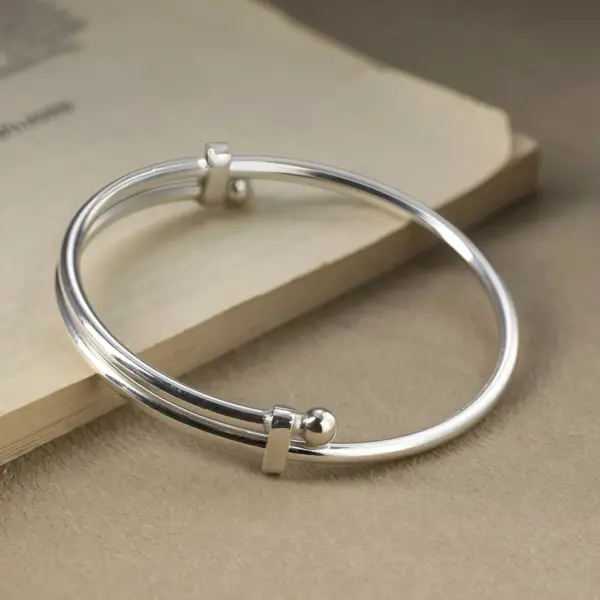
This listing separates inner diameter, bangle circumference, and recommended wrist circumference, so the labels can be compared instead of treating one number as the entire size.
Match the method to the bracelet construction
Clasp and chain bracelets: Start with wrist circumference, then use the product’s finished-length or recommended-wrist guidance. Decide how much movement you prefer only after confirming how length is measured. An extension chain provides a range, but it does not replace the need to measure.
Open or hinged bangles: These open for the wrist, so wrist circumference and the bracelet’s inner dimensions are the relevant comparison. Follow the product’s stated adjustment method; “adjustable” does not mean unlimited bending or resizing.
Closed slip-on bangles: The bangle must pass over the widest part of the hand. Measure the hand position specified by the seller and compare it with the seller’s inner-diameter or inner-circumference chart. A wrist-only measurement can be too small for this construction.
Bracelet stacks: Measure each intended position. The arm’s circumference changes above the wrist, and several clasps or wider profiles can change the amount of movement you prefer. Do not assume one stored measurement fits every position in a stack.
Before ordering from the silver bracelets collection, write down four things: wrist circumference, preferred fit, bracelet construction, and the exact meaning of the listed size. If the product page does not make that meaning clear, ask before converting the number yourself.
Frequently Asked Questions
Not automatically. A 16 cm label could mean finished length, inner circumference, or recommended wrist size, and each maps differently to your 16 cm wrist. Match your wrist figure to the measurement type stated in the listing, then account for the closure or adjustment range and your preferred amount of movement.
Yes, if it fits well and you compare the same bracelet construction using the seller's measurement method. Lay a clasp bracelet straight and confirm whether the seller includes the clasp and end rings; for a rigid bangle, compare inner diameter or inner circumference rather than outside width.
Use the product-specific guidance and your preferred amount of movement. Check whether an extension range covers your measurement, how the seller defines each size, and whether the return policy lets you exchange a fixed size that does not fit as expected.