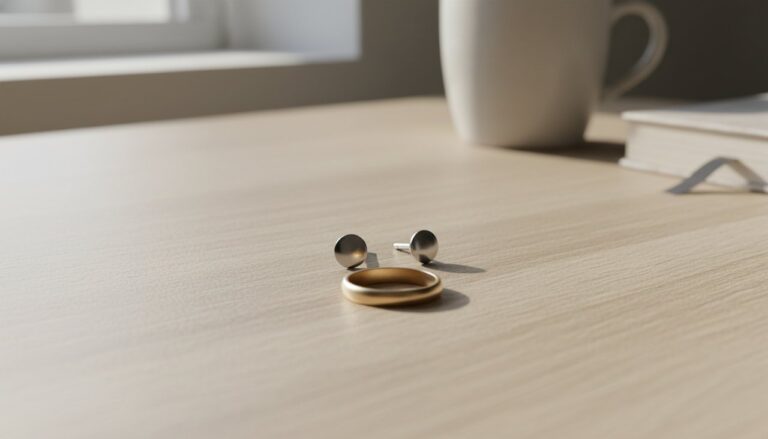

A black dress has no competing pattern, no texture to work around. Silver lands against it with high contrast — which means chain length, placement, and ring width all show up clearly. Treating each piece as a structural marker, rather than decoration, is the most direct way to make styling jewelry with black clothing feel deliberate without overworking it.
The Period
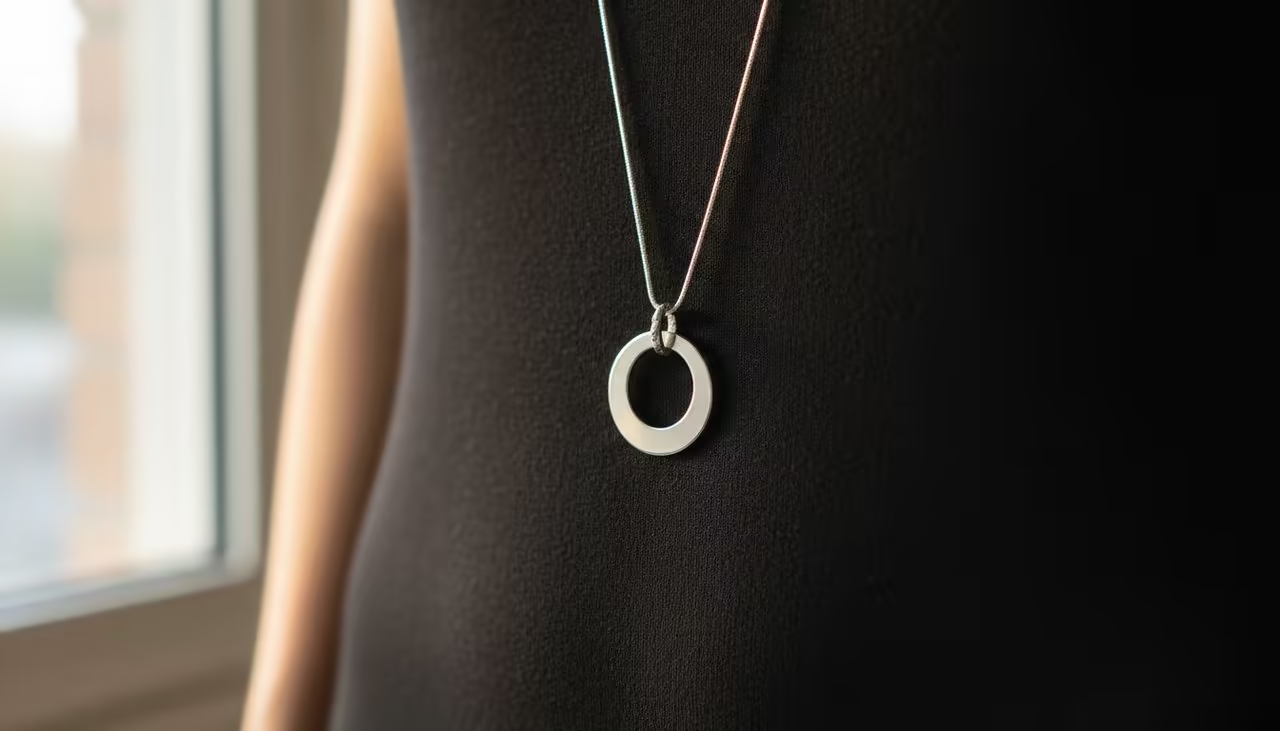
A single pendant against dark fabric creates one focal point and stops the eye there. Where that stop lands depends on chain length — and which length works depends on the neckline.
- A 16-inch chain sits at the collarbone. Pairs well with V-necks and scoop necks where the neckline already opens the chest area.
- An 18-inch chain sits just below the collarbone. A reliable default for crew necks and most everyday dress cuts.
- A 20-24-inch chain drops toward the sternum. Works with open or low necklines that provide enough bare skin for the pendant to read against.
A polished finish creates a sharper contrast against matte black fabric. A brushed or oxidized surface sits quieter — present, but without the hard edge. Against black silk, polished silver amplifies. Against black wool or knit, a brushed finish holds its own without competing with the fabric’s texture.
The Ellipsis
Fingers move across a keyboard. Three thin silver rings catch light in sequence as the hand shifts — one on the index, one on the middle, one on the ring finger. The result is a trail rather than a fixed point, guiding the eye along the hand’s motion.
Band width determines how that reads. Bands under 2mm stack without visual crowding. Bands at 3-4mm start to dominate individually — stacking more than two at that width tends to overload the hand. A useful combination: one slightly wider band paired with two thinner ones keeps movement in the composition without adding bulk.
- Match band widths within the same stack to keep the line uniform.
- Spread rings across at least two fingers so the hand doesn’t feel weighted on one side.
- Vary surface finish — one smooth, one lightly hammered — to add contrast without adding more metal.
- Before buying, finding the right ring size for each finger separately makes a practical difference when stacking across multiple fingers.
The Comma
Effective styling treats jewelry as a tool for composition rather than a decorative afterthought.
A hand reaches across a counter. A thin silver chain at the neck reflects the same cool tone as a ring on the finger. The eye moves between them without interruption — not because the pieces match, but because they share the same metal temperature.
Sterling silver is commonly described as 92.5% silver with 7.5% copper, and Jewelers of America notes that silver jewelry may be marked 925, .925, 92.5, or Ster. Polished sterling silver reads cooler and sharper against black than yellow gold or warmer plated finishes. The tonal consistency between a necklace and a ring is what creates the pause, not a coordinated set. The pieces can come from anywhere — they just need to stay in the same color register.
The Em Dash
One hand carries three stacked rings. The other is bare, reaching up to tuck a strand of hair. The contrast is immediate — the weighted side pulls focus, the empty side gives it room.
This works best when the dress itself is doing very little. A plain shift or a minimal column cut lets the asymmetry read clearly. Add structure or surface detail to the fabric and the contrast gets absorbed. The silver needs the negative space to function as an interruption rather than noise.
Keeping Silver Ready to Wear
925 sterling silver can tarnish faster when left unworn. Regular wear often slows the process, but surface finish still matters. When a piece needs attention, the right method depends on how the silver was finished — using the wrong one can remove more than tarnish.
- Polishing cloth — best for smooth, high-polish surfaces. Removes light tarnish without residue. Useful for regular care between wears.
- Silver cleaning solution — effective for some plain sterling silver pieces, but use cautiously. Avoid dips on oxidized, antiqued, plated, pearl-set, or stone-set jewelry unless the maker specifically recommends it.
- Ultrasonic cleaners — avoid for pieces with stones, open settings, or delicate construction. Repeated vibration can loosen settings over time.
Tiffany’s sterling silver care guidance also cautions against dip polishes. Store pieces separately in a soft pouch or anti-tarnish bag when not in use. The approach to keeping your silver clean is less about frequency and more about matching the method to the finish.