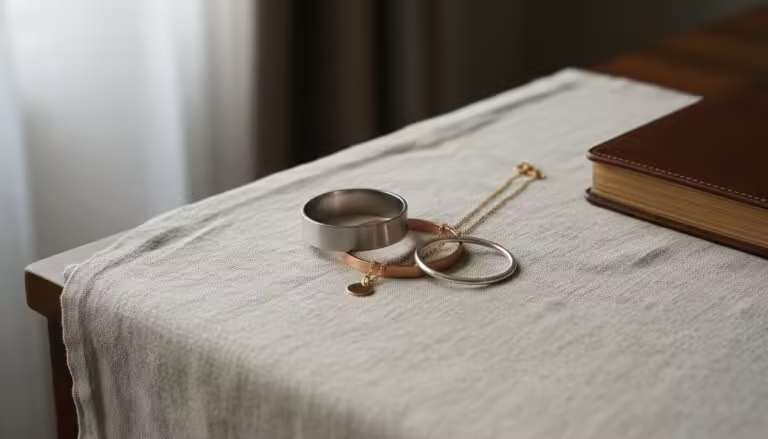

I often find myself hesitating at the kitchen sink, wondering if I should remove my ring before scrubbing a heavy pan. We tend to treat diamonds with a fragile reverence, yet we rarely discuss their actual physical limits. It is a small, daily calculation we all make when wearing fine jewelry.

Historical standards once dictated that diamonds were strictly for evening wear, meant only to catch the low light of chandeliers. It was not until the mid-20th century that the concept of a constant, daily-wear gem truly took hold. However, knowing a piece is meant for a lifetime does not automatically teach you how to manage it while typing, cooking, or lifting weights.
Wearing jewelry every day is much like owning a high-quality leather handbag. It is built to endure, but it is not immune to the physical realities of your environment. Maintaining its beauty requires a practical awareness of how it interacts with the world around it.
The challenge is not whether you are allowed to wear your jewelry constantly, but whether you understand the physical mechanics required to do so safely.
Real Risks
Many assume that because diamonds are the hardest natural substance, they are indestructible. In reality, diamonds possess internal grain lines where atomic bonds are weaker, known as cleavage planes. Think of these like the grain in a piece of wood.
A sharp knock at the wrong angle against a metal door handle can cause a stone to chip or crack along these internal lines. The force of a sudden impact travels directly through the rigid structure. Much of this risk depends on how the stone is physically mounted on your finger.
Traditional prong settings leave the edges of the stone exposed to the world. If you lead an active lifestyle, a bezel setting is a far more resilient structural choice. A bezel wraps the entire perimeter of the diamond in a solid rim of metal, offering 360-degree protection.
This metal rim acts as a physical shock absorber for the gem. By taking the brunt of high-frequency daily impacts, the setting ensures the stone itself does not have to absorb the blow. It transforms a delicate ornament into a durable companion.
Invisible Enemies
Physical impacts are easy to notice, but chemical threats to jewelry are entirely silent. The gold used in most settings relies on alloys for structural strength, and these base metals are vulnerable to common substances. This deterioration occurs through a process known as stress corrosion cracking. While some chemical reactions might lead to the minor annoyance of rings green finger marks, the deeper structural damage to the setting is a more serious concern.
Three main chemical offenders drive this silent damage in most homes:
- Chlorine concentrated in swimming pools and hot tubs
- Oxybenzone found in many chemical sunscreens
- Household bleach containing sodium hypochlorite
Repeated exposure causes the microscopic structure of the metal to become brittle from the inside out. Over time, the tiny prongs holding your stone can develop micro-fissures that are invisible to the naked eye. You likely will not notice the damage during a busy morning routine.
The first sign of trouble is often the total failure of the setting itself. When the metal snaps, the diamond can fall out entirely while you are simply going about your day. Regular inspections are the only way to catch this before the stone is lost.
How Your Diamond Loses Its Fire
If your ring looks flat after a few weeks of wear, the stone is rarely damaged. It is usually just trapped under a layer of daily residue. Natural skin oils, hand creams, and soaps create a thin film across the diamond’s facets.
This layer acts as a barrier, preventing light from entering the stone and reflecting back out. Visually, this loss of brilliance typically becomes obvious right around the 14 to 21 day mark of continuous wear. Restoring that fire and learning how to clean jewelry at home does not require a professional service.
A small bowl of warm water and a few drops of mild, non-soap dish detergent will lift the oily film effectively. A light brush with a soft bristle is all that is needed to clear the facets. However, you must evaluate your setting before attempting deeper cleans at home.
Avoid using ultrasonic cleaners if your jewelry features micro-pave settings. The intense microscopic vibrations that shake dirt loose can also vibrate those tiny, delicate stones right out of their mountings. For these pieces, a gentle soak is always the safer path.
Choosing for Life
Understanding the physical reality of jewelry allows you to make better choices from the start. If you lead a highly active life, steering toward bezel or channel settings ensures your stones remain sheltered. This practical approach makes fine jewelry feel effortless rather than burdensome.
The band design matters just as much as the setting itself. If you spend your day typing at a desk, a “comfort fit” design prevents the metal from biting into your skin. The slightly domed interior of the band makes long hours of wear physically forgettable.
Styling these pieces for casual wear is a matter of balance. A reliable guide for daily layering is the 70% minimal metal + 30% diamond principle. This ratio ensures your jewelry feels appropriate for both the grocery store and the office, even when you decide to stack bracelets or pair pieces with a simple jewelry black outfit for a cohesive, understated look.
Keeping the majority of your look focused on clean, bare metal allows the diamond accents to stand out naturally. It grounds the arrangement in reality, turning a formal piece into a reliable constant. Jewelry should be worn, not just stored in a box.
Removing a ring before chores is a practical habit, much like caring for a fine pair of leather boots. By respecting the cleavage planes of the stone and the chemical limits of the metal, everyday wear becomes entirely manageable. You can stop worrying about fragility and simply enjoy the weight of the piece on your hand.